
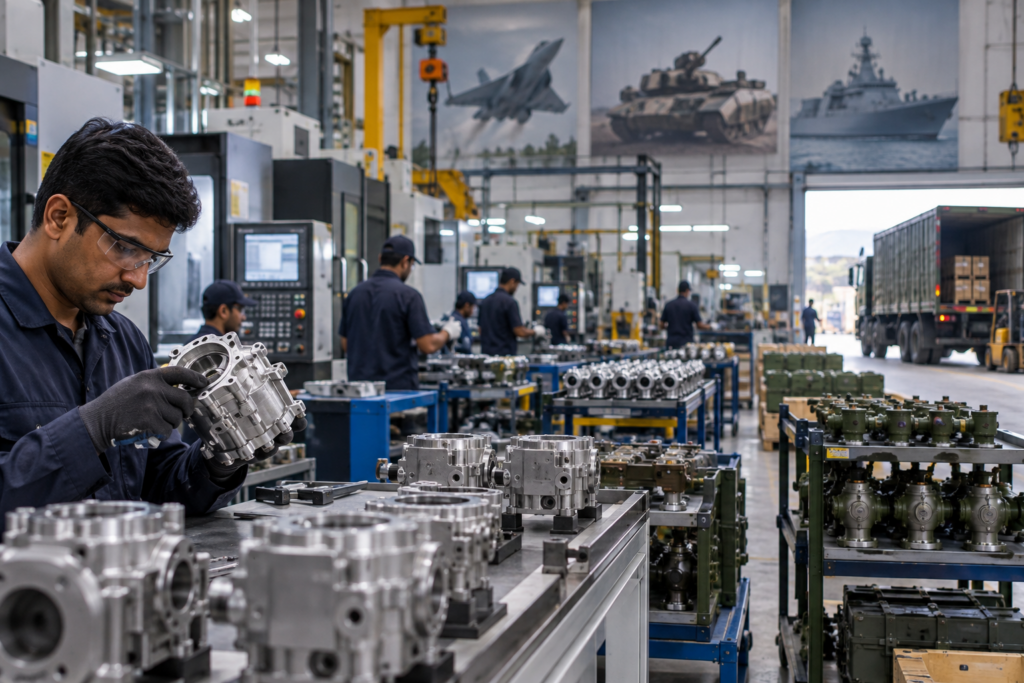
In 2017, an investigation into components supplied for the Dhanush howitzer found that bearings contracted as German-made had in fact been manufactured in China. The case captures precisely what the word “indigenous” certifies in Indian defence production. It describes where a platform is designed and assembled. It says nothing about what holds that platform together underneath.
The Output Is Real, and So Is the Dependence
India has built a genuine defence manufacturing base. The LCA Tejas, the Arjun main battle tank, the Akash missile system, the Pinaka rocket system, indigenous warships, and a widening range of unmanned systems mark an industry that has moved well past assembling imported kits.
The figures support this. Defence production reached ₹1.78 lakh crore in FY2025-26, up 15.6 per cent on the previous year and more than double the ₹84,643 crore recorded in FY2020-21. Exports hit ₹38,424 crore, a 62.66 per cent rise over FY2024-25’s ₹23,622 crore, spread across 145 exporters and more than eighty countries, with private industry contributing ₹17,353 crore of the total. The government now targets ₹3 lakh crore in annual production and ₹50,000 crore in exports by 2029.
These are real achievements. But production value measures what leaves the factory gate, not what the country actually controls. A platform can be built in India and still depend on foreign technology, foreign components, and a small number of foreign suppliers for its scheduled delivery, its upgrades, and its serviceability. The question that matters now is not how much India manufactures. It is how much of the capability behind that manufacturing India actually owns.
What Actually Counts as Strategic Dependence
No major defence producer makes every component of every system at home, and importing is not by itself a weakness. Dependence becomes strategic when three conditions converge: the component has very few qualified suppliers anywhere, an alternative cannot be developed and certified quickly, and access can be cut off by export controls or by a shift in a state’s foreign policy.
Cost share is a poor guide here. A part worth a fraction of a per cent of a platform’s value can still decide whether that platform is delivered on time, repaired in the field, or upgraded at all. Leverage sits with scarcity and qualification, not with price.
This is the layer Indian policy is finally reaching. At the Defence Industrial Conclave in March 2026, Defence Minister Rajnath Singh set a 2030 target for India to make the full range of drone inputs domestically, from moulds to batteries. The platform is the visible part of the problem. What sits beneath it is the bigger one.
Tejas: A Case Study in Borrowed Power
HAL has built substantial capability to manufacture the LCA Tejas. Its propulsion tells a different story. The aircraft flies on the F404-IN20 engine, manufactured by GE Aerospace, USA. The engine was ordered in 2021 under a contract for 99 engines with deliveries expected from 2024. The first engine did not arrive until March 2025, and FY2025-26 closed with six delivered against the promised eleven. The engine shortfall left a significant number of Mk1A airframes awaiting powerplants before formal handover to the Air Force.
GE has attributed the shortfall to difficulties restarting the F404 line after a long production gap and wider supply-chain disruptions; subsequent reporting has also linked delays to disruptions arising from the conflict in the Gulf. Supply has since improved, with a same-batch delivery of two engines reported in August 2026, and HAL has been working towards its first Mk1A handovers in the second half of 2026. The delay is being worked through. The dependence that produced it is not.
That exposure runs further down the chain than the engine maker itself. The engine charge amplifier, a small unit inside the F404’s own supply chain, became a constraint on Mk1A deliveries after it fell under Danish export restrictions, and HAL began developing a local substitute. In September 2025, Denmark amended its list, and supply resumed.
That resolution is worth examining closely. Supply resumed because a foreign government changed its policy, not because an Indian alternative reached qualification. The vulnerability was relieved. It was not retired. It remains in place, waiting on the next government that is less accommodating.
Dhanush: Dependence Beneath an Indigenous Platform
The Dhanush, an Indian indigenisation and upgrade of the Bofors FH-77B. It was inducted into service in April 2019, with its first batch of six guns. This made it India’s first domestically designed and built artillery gun in decades, ending a drought in towed artillery induction that stretched back to the original Bofors purchase of the 1980s. Production has continued since 2021 under Advanced Weapons and Equipment India Limited, following the Ordnance Factory Board’s corporatisation. Of an order for 114 guns, more than fifty had been delivered by mid-2025. The programme has run into dependence twice, and each failure exposes a different weakness.
The first is a scheduling failure. In 2023, production was paused because a spare needed for one of the gun’s sub-assemblies could not be procured in time. The spare was imported, and delays affecting the Indian vendor responsible for sourcing it stopped the line entirely, on a platform officially classified as indigenous.
The second is the integrity failure described at the outset: a wire race roller bearing, a critical structural component, supplied against forged certification and traced to a Chinese manufacturer. One failure is about whether a part arrives at all. The other is about whether the part that arrives is what its paperwork claims. Both sit several layers below the platform’s headline classification. Neither shows up in a production figure.
The Dependence That Is Not a Component at All
Components are, in a sense, the easier version of this problem, because a component can eventually be reverse-engineered and qualified. Materials cannot be sourced into existence.
India remains heavily dependent on imports of rare-earth permanent magnets, an input that feeds missiles, radars, satellites, and, most acutely, drones. Chinese export controls have tightened since 2023: licence approvals have taken up to two months, and prices for neodymium and dysprosium have moved sharply. A government disclosure to Parliament in April 2025 found that 39 per cent of flight controllers in DGCA-certified small UAS models registered in India were sourced from Chinese manufacturers.
India’s response is the Rare Earth Permanent Magnet scheme, approved in November 2025 at roughly ₹7,280 crore, combining sales-linked incentives with a capital subsidy and targeting 6,000 tonnes a year of integrated domestic capacity. The scale of the answer is a fair measure of the size of the problem, and it is why the 2030 drone-inputs target is harder than it sounds. A magnet is not a part that simply gets qualified. It is an entire industry, mining, separation, alloying, sintering, coating, that has to be built up from the ore.
Building It Is One Problem. Keeping It Running Is Another.
Getting a platform out of the factory puts it on the parade ground, but keeping it flying, firing, or sailing for thirty years is a separate industrial task altogether. This is where component dependence changes character. A supply disruption on the production line is simply an industrial problem, costing time and money. The same disruption fifteen years later, when a spare is unavailable or a repair needs a facility abroad, becomes something else entirely: an aircraft that does not generate sorties, a gun that does not fire.
Both policy and industry are beginning to close this gap. In April 2026, GE Aerospace and the Indian Air Force signed a contract to establish an in-country depot for the F404-IN20, keeping engine overhaul inside the country. The sixth Positive Indigenisation List, notified in August 2026, covers 405 items worth about ₹3,070 crore, drawn from the Su-30MKI, the T-90, and other in-service systems. That is a sustainment list, not a production list, and the difference matters more as exports grow. Selling a platform abroad creates a decades-long obligation to supply spares, maintenance, and upgrades. Every unresolved dependency in the supply chain becomes a question mark hanging over the export offer.
What India Has Built, and Where It Stops
The policy architecture already reaches below the platform. The 2019 Policy for Indigenisation of Components and Spares set the direction, and the SRIJAN portal has since created real visibility into items traditionally bought abroad. More than 33,000 items have been offered for indigenisation through June 2026, and over 15,700 have already been indigenised, worth roughly ₹9,000 crore in import substitution over five years, with about ₹10,000 crore of orders placed on domestic vendors through March 2026. Six Positive Indigenisation Lists now cover 5,417 items.
That is a substantial base, and the right instrument. But identification is only half the work. A published list creates visibility of demand. It does not create a supplier to meet it.
Why the Vendor Base Does Not Form
To replace an imported component, a vendor has to meet the quality, certification, qualification, tooling, and traceability requirements specified for that component and platform. In aerospace, for example, an OEM or supplier may need to meet standards such as AS9100, along with programme-specific approvals, testing and qualification requirements. For many listed items, that arithmetic simply does not close.
Qualification takes years and real capital, often for an order of forty units, once. The imported alternative is already qualified and already amortised across a global customer base, so it wins on unit price nearly every time. A rational Tier-2 supplier will not fund a multi-year qualification programme for a one-time order at that volume. And the firms best equipped to do the work, with the metallurgy and process control it demands, already have better-paying alternatives in commercial aerospace and automotive.
This is a procurement design problem, not a technology one. Five changes would shift the calculation:
- Multi-year rate contracts in place of annual tenders. Volume certainty across five to seven years justifies tooling investment. A single-year order rarely does.
- Life-cycle spares bundled with production orders. Tendered separately, neither is worth qualifying for. Tendered together, many components become viable.
- Funding qualification, not just development. iDEX and the Technology Development Fund support the route to a prototype, but products die in the gap between a prototype and a certified production article.
- Evaluating total exposure, not unit price. Under lowest-bidder evaluation, an amortised import defeats a domestic first article almost every time. Resilience requires pricing in the risk of not having the part at all.
- Access to export platforms for qualified Indian components. A supplier serving both domestic and export volume has a business. One serving a single programme has a project, and projects end.
SRIJAN, iDEX, and the Defence Industrial Corridors need to work as one continuous pathway, from identification to sustainment, rather than as three schemes a company has to navigate on its own.
The Next Phase
India’s first phase of defence self-reliance answered a real question: can the platform be designed and built here? The answer is now clearly yes, and the production and export figures are the evidence for it.
The next phase asks a harder one. Not whether India can manufacture every component, since no country does and autarky was never the goal, but whether India knows precisely where external dependence creates strategic risk, and whether it is willing to fund the unglamorous work of closing those gaps: materials, qualified suppliers, test and certification capacity, repair facilities, spares pipelines.
Tejas and Dhanush show the same thing from different directions. A dependency buried several layers inside a platform stays invisible until it surfaces, as an airframe without an engine, a line stopped for a spare, or a bearing that was never what it claimed to be. The measure of the next decade is not how much India builds. It is how little of what India builds can be stopped by someone else’s decision.
References
All figures cited are as reported on the dates shown. Programme figures in this sector move quickly and should be re-checked against the latest official releases before republication.
1. Defence exports skyrocket to record Rs 38,424 crore in Financial Year 2025-26, Press Information Bureau, 2 April 2026. https://www.pib.gov.in/PressReleasePage.aspx?PRID=2248124®=3&lang=1
2. India’s defence production reaches Rs 1.78 lakh crore in 2025-26 financial year, The News Mill, 17 June 2026. https://thenewsmill.com/2026/06/indias-defence-production-reaches-rs-1-78-lakh-crore-in-2025-26-financial-year/
3. Rajnath Singh inaugurates Defence Industrial Conclave, pushes drone self-reliance by 2030, ANI, 19 March 2026. https://aninews.in/news/national/general-news/union-minister-rajnath-singh-inaugurates-defence-industrial-conclave-pushes-drone-self-reliance-by-203020260319141646/
4. GE delivers sixth F404 engine for Tejas Mk1A to HAL, cites war in Gulf for delay, ThePrint, 1 April 2026. https://theprint.in/defence/ge-delivers-sixth-f404-engine-for-tejas-mk1a-to-hal-cites-war-in-gulf-for-delay/2894360/
5. GE to deliver two F404 engines to HAL in August — first same-batch twin delivery for Tejas Mk1A, IDRW, 2026. https://idrw.org/ge-to-deliver-two-f404-engines-to-hal-in-august-first-ever-same-batch-twin-delivery-for-tejas-mk1a/
6. Not just engines, Tejas Mk-1A delivery could be hit over key Danish part, now on export blacklist, ThePrint, 2025. https://theprint.in/defence/not-just-engines-tejas-mk-1a-delivery-could-be-hit-over-key-danish-part-now-on-export-blacklist/2272527/
7. Denmark tweaks its banned exports list, delivery of critical system for Tejas Mk1A starts, ThePrint, September 2025. https://theprint.in/defence/denmark-tweaks-its-banned-exports-list-delivery-of-critical-system-for-tejas-mk-1a-starts/2737961/
8. GE Aerospace, HAL finalise key tech transfer terms for F414 jet engine production in India, Swarajya, 2026. https://swarajyamag.com/defence/ge-aerospace-hal-finalise-key-tech-transfer-terms-for-f414-jet-engine-production-in-india
9. GE Aerospace signs contract with the Indian Air Force to help establish an in-country depot for F404-IN20 engines, GE Aerospace, April 2026. https://www.geaerospace.com/news/press-releases/india/ge-aerospace-signs-contract-indian-air-force-help-establish-country-depot-f404-in20
10. Defence Ministry announces sixth Positive Indigenisation List comprising 405 strategically important items, Akashvani News (Prasar Bharati), 18 August 2026. https://newsonair.gov.in/defence-ministry-announces-sixth-positive-indigenisation-list-comprising-405-strategically-important-items/
11. India’s Defence Ministry adds 405 items to positive indigenisation list, Airforce Technology, August 2026. https://www.airforce-technology.com/news/india-defence-pil-items/
12. AWEIL resumes production of Dhanush artillery guns, Raksha Anirveda, 2023. https://raksha-anirveda.com/aweil-resumes-production-of-dhanush-artillery-guns/
13. Fake, cheap Chinese spares for Indian-made Bofors guns Dhanush: CBI FIR, Deccan Chronicle, 21 July 2017. https://www.deccanchronicle.com/nation/current-affairs/210717/fake-chinese-spares-for-indian-made-bofors-guns-dhanush-cbi-fir.html
14. Dhanush artillery guns: delivery status against the 114-gun order, Deccan Herald, 2025. https://www.deccanherald.com/india/shot-arm-army-soon-delivery-2149300
15. India unveils $800 million push for rare earth magnet production, Gulf News, 27 November 2025. https://gulfnews.com/world/asia/india/india-unveils-800-million-push-for-rare-earth-magnet-production-1.500361616
16. China’s dominance overshadows India’s drone ambitions despite battlefield breakthroughs, National Herald, 2026. https://www.nationalheraldindia.com/national/chinas-dominance-casts-shadow-over-indias-drone-ambitions-despite-battlefield-breakthroughs
17. China tightens export curbs on rare earths and related technologies, Down To Earth, 2025. https://www.downtoearth.org.in/energy/china-tightens-export-curbs-on-rare-earths-and-related-technologies